Laura Welzenbach - Head of Ars Electronica Export
Laura Welzenbach - Head of Ars Electronica Export
Laura Welzenbach - Head of Ars Electronica Export
17 min read
17 min read

[No. 004]

A conversation with Laura Welzenbach, Head of Ars Electronica Export, on art, technology, ethics, and the future of creative practice.
We met Laura Welzenbach during a lecture organized by Hosq, where she spoke about the evolution of Ars Electronica, from a festival founded in Linz in 1979 into one of the world’s leading ecosystems connecting art, science, and technology. As Head of Ars Electronica Export, Laura develops international exhibitions, workshops, and residencies that explore the relationship between society and emerging technologies. In this conversation, we discuss AI, ethical boundaries, the role of discomfort in art, and why human connection matters more than ever in an increasingly digital world.
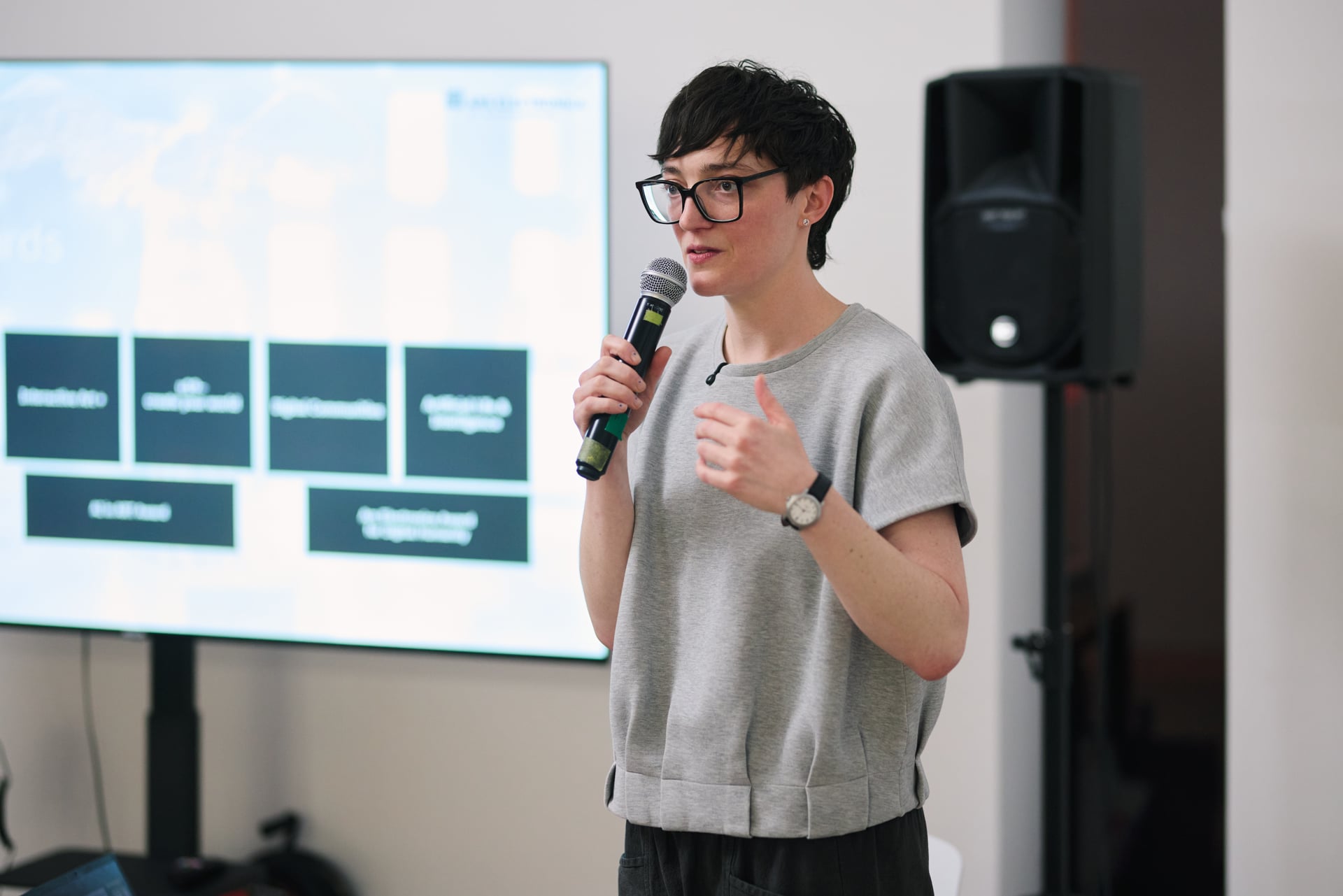
A Kitchen Talk with Laura Welzenbach, organized by Hosq, Yerevan 2026.
Photo: Hosq, Mitya Lyalin.
Ars Electronica was founded around the idea that art, technology, and society must be discussed together. Has that triangle changed in the age of AI platforms and surveillance capitalism?
No, quite the opposite—this triangle has become even more relevant and entangled in the age of AI. At the core of Ars Electronica’s vision and mission lies the belief that society must be a central part of negotiating the frameworks that shape our futures, especially in technological and digital developments. Art serves as our consultant, navigator, and guide, revealing diverse perspectives on our increasingly complex world.
You often speak about creating encounters between art and science. But do these fields actually understand each other, or are they still largely speaking different languages?
I think art and science are driven by similar, if not identical, motivations. From my perspective, actors in both fields are driven by a deep curiosity, by the desire to understand complex phenomena, and by the need to navigate the unknown while identifying relevance within a broader context. While scientists and artists may employ different methods and produce different outcomes, their core motivation could be the same.
Where do you personally draw ethical boundaries? Are there technologies Ars Electronica would refuse to platform or collaborate with?
Ars Electronica as an organization and I as an individual may draw different lines, but we share a commitment to bringing people to the table to co-create. We must develop tools to work through disagreement and find ways to collaborate across our differences. We are committed to finding a framework where listening guides us in staying critical.

Tender Soul of Ocean: recall / WHYIXD (TW), Kling Klang Klong (DE)
In Tender Soul of Ocean: recall, WHYIXD collaborates with Berlin sound collective KLING KLANG KLONG to transform real-time wind data and visitors’ movements into shifting fields of light and sound. The work blurs the boundary between viewer and installation, inviting visitors to become co-creators of an environmental rhythm.
Photo: vog.photo
Artificial intelligence is transforming creative work very quickly. Are current conversations around AI art too focused on tools and aesthetics, while ignoring labor, ownership, and ethics?
Yes! People must connect with these complex layers of technology. Understanding that using AI impacts people in other parts of the world—and maybe even our future selves—is tremendously important.
Is the art–science field becoming too solution-oriented? Can art still simply raise uncomfortable questions without needing to propose innovation?
Art must do exactly that: raise uncomfortable questions without needing to propose innovation. It should never be about innovation as a goal—it can inspire or activate it, but should not be driven by that purpose. Humans need to become more comfortable moving through discomfort and uncertainty while still cultivating empathy and togetherness. Art can help us do this.
Ars Electronica transformed Linz’s international image from an industrial city to a globally recognized media-art hub. How visible is that transformation in everyday life for residents?
Through the year-round program at the Ars Electronica Center, the stories about the impact of technology in our daily life are always accessible for people who live in Linz. And there are many other actors and organizations in Linz who carry this spirit to the public spaces. To name a few; our Art University features remarkable programs, and students bring their work and discussions to public spaces; Stadtwerkstatt (STWST), servus.at, radio FRO, dorf.tv, and festivals such as AMRO, FMR, Crossing Europe, and Stream, as well as numerous artist-run spaces are vibrant and active. The city's (media) art scene thrives because of these many initiatives that keep the conversation active and public.
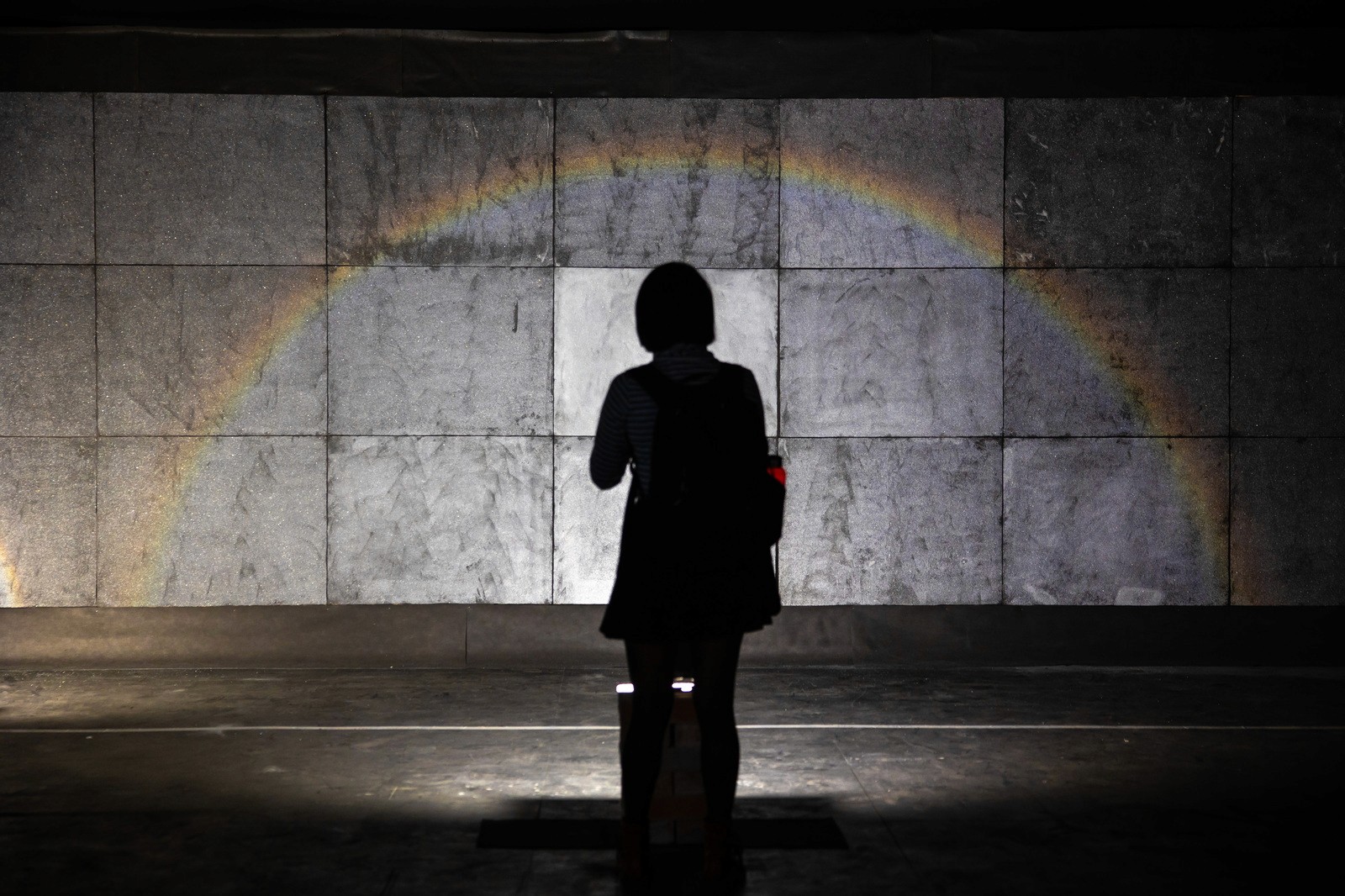
RAINBOW / Yari Häfele (AT)
The installation reflects both the physical phenomenon of the rainbow and its symbolic meanings. @POSTCITY
Photo: tom mesic
What are the biggest challenges facing institutions like Ars Electronica today: funding, political polarization, AI acceleration, audience fragmentation, or something else?
Yes, and I would like to add that it is important to stay connected even if there is disagreement. I know some people, also in the art world, do not deserve attention, but I suggest that a full boycott or cancellation is only the right answer when talking about big tech products or other capitalist-driven aspects. The art scene needs to stay in touch and find ways to negotiate disagreements together. Compared to the rest of the world, there are relatively few of us in this world sharing these ideas and values. If we cannot find ways to work together in a healthy manner, how can we expect other fields—such as politics, industry, or business—to do the same?
What misconception do people most often have about art–science collaboration?
A common misconception about art-science collaborations is that art merely serves to beautify scientific work. The goal should always be an exchange on equal footing. The exchange here is multidirectional. The one-directional way where scientists provide knowledge to transfer them into illustrations, games or installations is science communication—something different and also something very valuable but different.
Has there been a project that fundamentally changed your own thinking about technology?
With every collaboration and exchange, I learn something new about art, technology, and society—and this never ends. For me, changing my mind about things I thought I understood is an ongoing process that I value so much and feel so privileged to do.

Phonos / Marc Vilanova (ES)
Liminal Ring explores humanity’s desire to control nature through precisely directed laminar flows. Contrasting nature’s Phonos is a sculptural installation of speakers attempting to emit infrasounds: vibrations below human hearing that shape more-than-human worlds. Programmed by an algorithm modelled on swarm behaviour, it generates an intimate polyrhythm that attunes us to imperceptible acoustic ecologies.
@POSTCITY
Photo: vog.photo
What kind of future currently worries you the most?
Phew, this is tricky. I hope we find ways to stay connected in the real world. Of course, we can use digital technology to do that, but I hope we discuss our deepest worries, anxieties, and curiosities not only with the internet or bots, but with friends and actual people. I hope we don’t unlearn that failure, disagreement, discomfort, and disappointment—though not pleasurable or nice—are grounds for learning. They make us reflect, rethink, and revise. And that process is a good thing.
If Ars Electronica were founded today in 2026 instead of 1979, what would its mission be?
Ars Electronica’s mission would probably remain the same, but it would grow and manifest differently. Perhaps there are other formats—beyond a center, a festival, or an award—that the world needs right now.
What kinds of collaborations do you think are realistically possible with a country like Armenia, especially considering its strong tech sector, complex geopolitical situation, and emerging contemporary art scene?
All collaborations are possible. We just need to find the right way, format, timeline, and workflow that are feasible for everyone involved and, most importantly, take time and space to work on for real, sustainable connection in Armenia. I am very excited that I had the chance to visit Yerevan for the first time with the help of Hosq, a really amazing organization that supports young talent and creativity. I truly hope we can continue the collaboration and find ways to stay in touch with Yerevan, Armenia, and the community here.
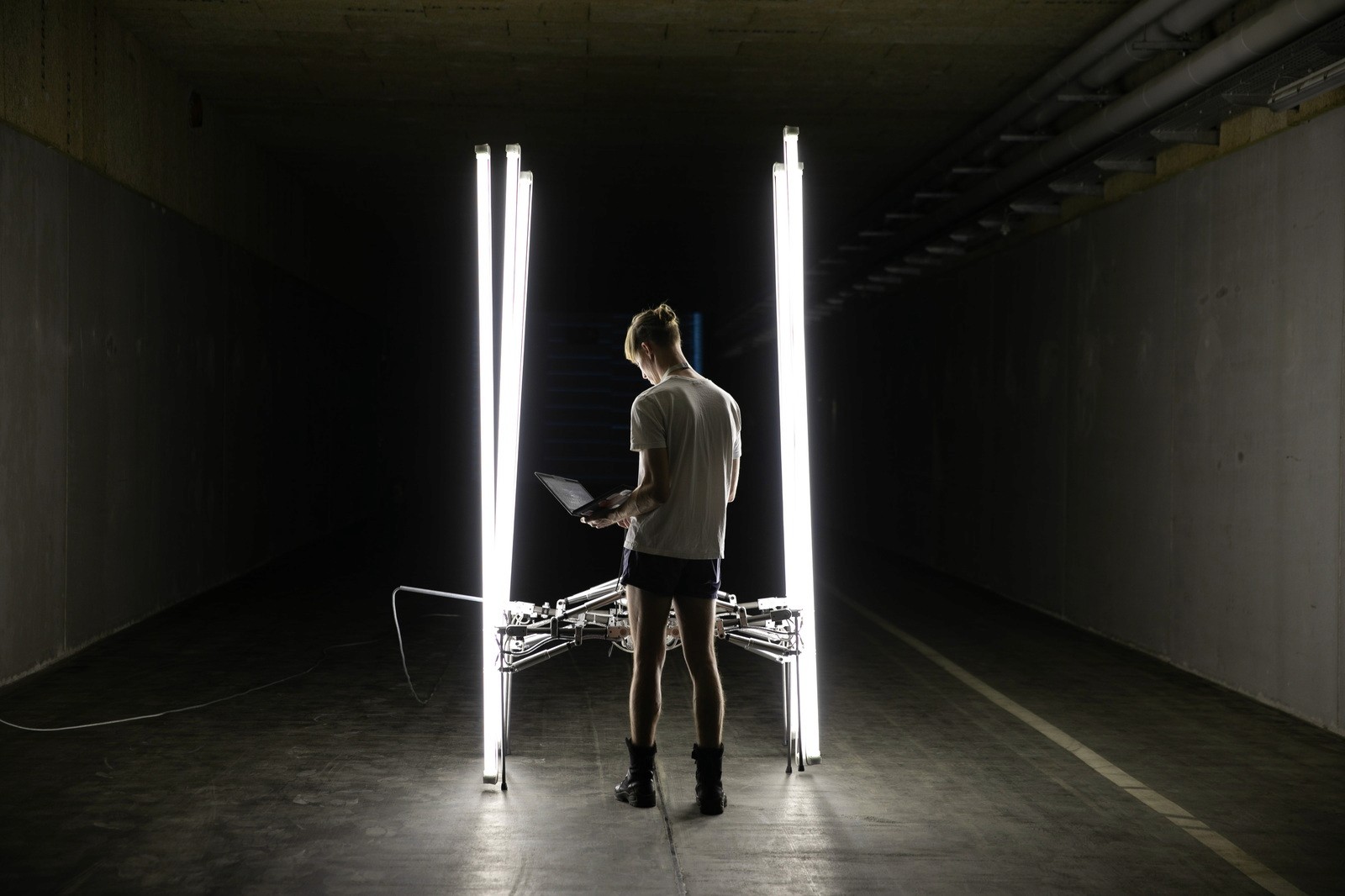
CRYPTID / Michael Candy (AU)
Liminal Ring explores humanity’s desire to control nature through precisely directed laminar flows. Contrasting nature’s Photo showing the artist Michael Candy with his artwork.
A monumental robotic light sculpture, CRYPTID exists as a vibrant anomaly in contrast to contemporary automata, sharing a presence both radiant and reserved.
Photo: vog.photo