Edward Mkhitaryan: What Happens Before the Curtain
Edward Mkhitaryan: What Happens Before the Curtain
Edward Mkhitaryan: What Happens Before the Curtain
34 min read
34 min read

[No. 004]

ON THE BEGINNING
Where does your story start, and how did you arrive at the role you hold today?
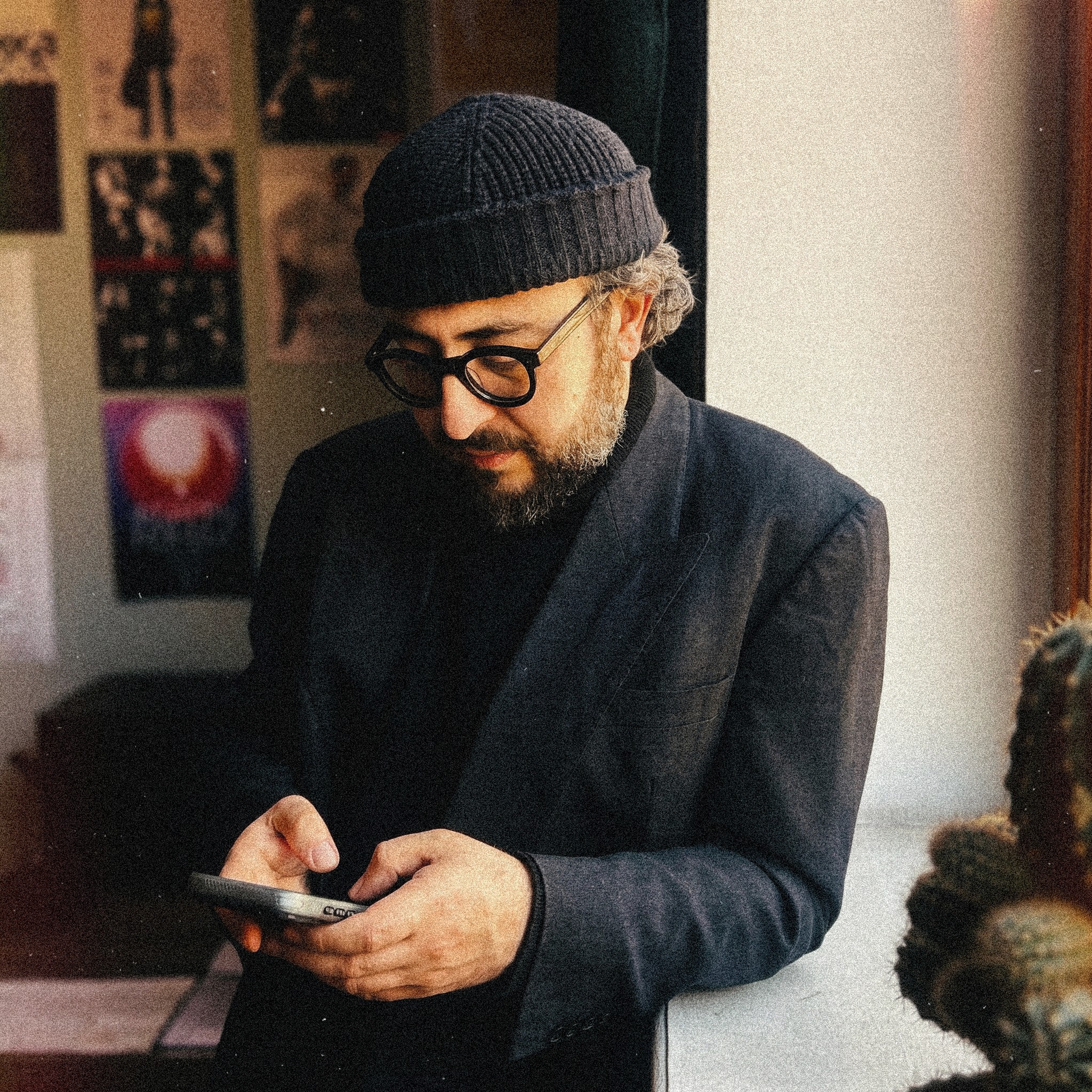
I grew up backstage — literally. My father, Tigran Mkhitaryan, was a First Artist and director of the Yerevan Drama Theatre, later became its Executive Director, and went on to co-found two more theatres in Armenia: the Children's Musical Theatre and what is now the Hamazgain Theatre. So theatre, for me, was never an abstraction. It was schedules, rehearsal conflicts, technical problems, the smell of a building that never quite closes. That experience gave me something I couldn't have studied: an understanding of theatre as a system. A living, complicated, financially precarious, artistically essential system.
Formally, I started at the School-Studio of MKhAT in Moscow on a producing programme. But I left before finishing — not because I stopped caring, but because I understood that the entertainment industry is too wide for any one institution to contain. Each form deserves someone who truly understands it. So in my third year I shifted, went into PR and advertising, and joined Leo Burnett — one of the legendary agencies — working on campaigns for Coca-Cola, Snickers, Chupa Chups, Unilever. That was my practical school of producing: how to move fast, how to read a room, how to protect an idea through many hands.
Then Los Angeles. UCLA, entertainment studies, industry people as professors — working producers, agents, lawyers, studio executives. After that, New York Film Academy for directing and production, a local college for business fundamentals. And in between all of it: San Francisco, the Bay Area, Silicon Valley — full of young, brilliant, sometimes genuinely genius people who reminded me that my real job as a producer is to give talented people what they need to stay sane and do what they do best. I founded Wear A Hat Productions in the US — music videos, short films, documentaries, features, festival runs. And eventually Armenia called, through real work, real projects, real people. I stayed.
What shaped you along the way — the people, the cities, the failures, the turning points?
Los Angeles taught me several things at once: that attention is a resource, and you compete for it whether you want to or not; that ethics matter more in a small industry than people admit; and — this one took longer to learn — that knowing when to slow down is as important as knowing when to accelerate. Probably that calibration, the moment of deliberate deceleration versus the moment of total full-speed, is the most essential skill for any producer. Samuel Aroutiounian, who was my mentor there, had a phrase I still carry: "Shut up, observe, learn." Moscow hardened me. I met great artists there, but also billionaires, and the combination taught me something about scale and about the gap between ambition and infrastructure.
As for failures — I have so many, and I am genuinely grateful for all of them. The one that changed me most was a startup called KOX TV—my first and last venture into that world. The idea was mobile TV: one app where you could access music videos, animation, adult content, everything — across the many phone models that existed then. I got serious investors, licensed content from MTV, Nickelodeon, major studios. The platform was technically strong; our video quality and bandwidth were better than YouTube at the time. And then the first iPhone arrived.
I didn't lose because of the iPhone directly — I lost because I couldn't see what was coming after it: millions of independent content creators, the complete restructuring of distribution, the collapse of the licensed-content-as-premium model. That gap between what I knew and what I failed to anticipate — that was the real wound. Not the declining subscriptions. The self-disappointment of a person who understood art but hadn't developed the analytical tools to filter signal from noise. My investors rescued me from that spiral, helped me sell the platform to a rising streaming company in Russia, and it turned out to be a significant exit. I didn't want to spend it on luxury or real estate — those felt like the wrong answer to the question I was still asking. So I went to California to study, to network, and to understand what I had missed.
ON PRODUCING
What does a theatre producer actually do in Armenia?
Nobody fully knows yet — and that's not a complaint, it's a description of where we are. The position of producer in a repertoire theatre is genuinely new to this country. The first person to establish that function in a municipal theatre was my friend and partner Jemma Sahakyan. It was she, together with director Grigor Khachatryan — to whom I am endlessly grateful for taking that risk — who brought me in as the first Chief Producer at the Yerevan Drama Theatre. The same theatre where my father once served as Executive Director during the Soviet era, which in practical terms meant something close to what a producer does today.
So right now, the honest answer is: the producer here is often the person explaining to the institution what a producer is. And I find that genuinely thrilling. We are building the function as we perform it.
In concrete terms: budget architecture, partnership development, audience strategy, legal and HR frameworks, communications, production value. But above all — building the conditions that allow artistic work to happen at a level the theatre deserves. My focus at this stage is development: bringing in new collaborators, raising production standards, rebuilding the theatre's prestige, and most importantly, creating the infrastructure that makes the theatre genuinely attractive to sponsors and positions it as what it should be — a high-value cultural institution, not a subsidised relic.
What is the first decision you make when a new project lands on your desk?
Who is this for? Not as a marketing question — as an artistic one. If the team can't answer that clearly, nothing else follows.
But alongside that, I always ask: does this project have benefits for everyone's development — cast, crew, audience? Is there something new in it, even a small new thing, for the people who will sit in the dark and watch? Will it teach the team something they haven't done before? And critically — will it bring us the next project? Each production has to open a door that wasn't open before. If I can do something we've already done, there's no point. That applies to a music video as much as to a theatre production.
When do you say no to a production, and when do you fight for one no one believes in yet?
Steve Jobs said that Apple is defined not just by the products it made, but more by the products it decided not to make. That idea has stayed with me. Not doing is sometimes the harder, more important act. Even a good project can be the wrong project — wrong for this moment, wrong for this team, wrong for this institution. And sometimes that means rejecting something genuinely good because it simply isn't yours to do.
I fight for work that makes the people closest to it uncomfortable. That discomfort is usually a sign something real is at stake.
ON AMBITION
What do you still want from this role that you have not yet had?
A production that genuinely surprises the city. Not shocks — surprises. Something that makes Yerevan feel like a place where a certain kind of thought can happen publicly, in a room, with strangers, in real time. I want that at least once. Maybe more than once.
What kind of play would you love to bring to the Drama Theatre — one with social weight, ideological value, and something important to say to this country right now?
The list is long, and I've learned that some plays have to wait for their right social and economic moment — you can't force a work into a context that isn't ready for it.
But the first one I would fight for right now is Peter Weiss's Marat/Sade. The full title alone contains everything this country needs to argue about: the boundaries between art and politics, between revolutionary idealism and institutional power, between the individual and the collective. It's a play that holds a mirror up without pretending to hold an answer. That feels necessary here, now.
ON THE WORK
Which play was harder to bring to life, and why?
The Little Prince was harder than it looked from the outside. It was among the first multimedia productions at the Drama Theatre — video, animation, original score, live performance running simultaneously, all integrated. The technical infrastructure for that kind of work simply did not exist in the building. We built it as we went.
But the hardest part wasn't the technology. It was convincing everyone involved that the risk was worth taking before there was any evidence it was. That requires a specific kind of collective trust, and building that trust is slower and more demanding than solving any technical problem.
I have to name the people who made it real. Izabela Chichonska from Poland took my producer's concept and — together with animation artist Gor Sahakyanc of Sahakyanc Studio and director Grigor Khachatryan — expanded it into something far larger than what I had imagined. And my co-producer Samvel Grigoryan navigated a budget risk that had no precedent in this theatre. Without that specific group of people, the idea stays an idea.
ON THE COLLECTIVE
How would you describe the team you build around a production?
Someone once said the best collaborators are people who become almost psychiatrically obsessed with the material — who live only for the work and the process — but who still know where the deadline is. That's my definition of a teammate. It also implies something else: they've done serious work before. They know how to function inside a collective without losing themselves in it.
I look for people who can hold uncertainty without collapsing into false clarity too early. A production is a long period of not knowing exactly what it will be. The team has to be able to work in that state.
Is there a colleague who changed how you see your own work, and what did they do?
Several people, but two in particular.
Samuel Aroutiounian — my mentor in Los Angeles — taught me the discipline of observation. Before you speak, before you decide, before you react: watch. That sounds simple and is almost impossible in practice.
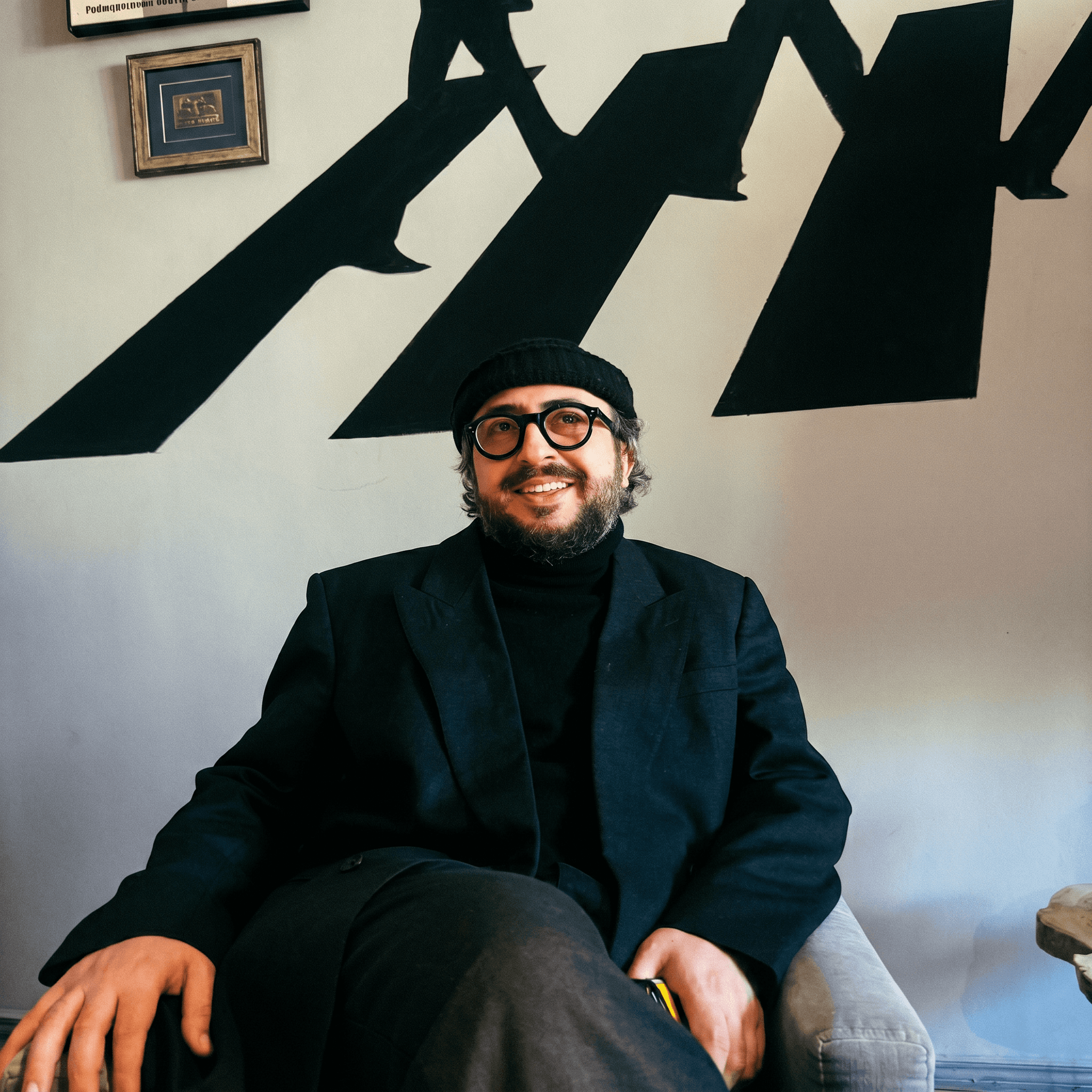
And working alongside Milla Jovovich during a documentary project changed something more fundamental. Being around an artist of that level made me understand that a producer's job is not to control the creative process — it is to protect the space in which an artist can take real risks. The better the artist, the more sensitive you have to become to atmosphere, timing, and trust. That realization reshaped how I approach every collaboration since.
ON THE ARMENIAN THEATRE INDUSTRY
What would you change in Armenian theatre tomorrow, and what would you refuse to touch?
Tomorrow, I would change the relationship between theatres and their actual audiences. Most institutions here still communicate as if the audience is a passive receiver. I'd make that relationship genuinely two-directional — real feedback, real dialogue, the audience as a long-term creative partner in the life of a season.
What I would refuse to touch is the Repertoire Theatre as a form. Not out of nostalgia — I have no interest in preservation for its own sake. But the repertoire model, when properly structured and properly funded, is one of the most sophisticated institutional forms the performing arts have ever produced. The goal is not to protect it from the present — it's to build around it the financial and organizational infrastructure that makes it genuinely strong. A well-run institution doesn't have to choose between artistic depth and institutional health. I'm here to prove that.
Where does Armenian theatre speak to the world, and where is it still talking only to itself?
Theatre is theatre regardless of nationality. It is a research centre — for form, for true questions, for the kind of presence that no screen can replicate. Armenian theatre, after a long period of stagnation, is continuing a search for its own contemporary language. That search is real and it's happening.
It speaks to the world when it trusts its own specificity — when it doesn't try to translate itself into something more legible for an imagined foreign audience. The work that travels is usually the work that never tried to. It talks only to itself when it uses cultural references as a wall rather than a door — when belonging is a precondition for understanding.
People have been predicting the death of theatre for two thousand years. Nothing has killed it. Some may not love it as a form, but no one would want to live in a society where it does not exist.
ON THE WORK ITSELF
What was the hardest moment in your career, and what did it expose about working in this country?
The hardest thing was understanding that in Armenia, culture is often carried by personal sacrifice instead of functioning systems. People here can be extraordinarily talented and emotionally devoted. But devotion becomes dangerous when it replaces planning, budgets, communication, and accountability.
The problem is rarely talent. The problem is the structure around talent. Too often, artists are expected to survive chaos and still produce beauty. I respect that resilience deeply. But I do not want it to remain the model.
That understanding turned me into a different kind of producer — less interested in making projects happen at any cost, more interested in building conditions. Because at any cost is not a cultural strategy. It's a way of burning people out and calling it dedication.
ON STAYING
You chose Armenia and stayed. What keeps you here?
The scale. Not as a limitation — as a condition.
In a small cultural ecosystem, what you build actually matters in a measurable way. You can see the effect of your decisions in real time. In larger markets, you can work for years without ever knowing if anything landed. Here, the feedback — even when it's slow — is immediate in a different sense. You're never far from the consequence of your choices. That is uncomfortable and addictive in equal measure.
And the work isn't finished.
ON LEAVING
What would have to happen for you to leave Armenia for good, and what would you take with you first?
I would leave if the conditions for honest work closed — not temporarily, not due to a difficult period, but structurally. If the institution became a place where the form exists but the possibility of real content doesn't.
What I'd take first: the working relationships. Everything else can be rebuilt.
CLOSING
Of all the productions you have worked on, which one do you love the most, and why that one?
At this point in my career, I've mastered — or at least practised — the art of choosing and rejecting projects deliberately. So I can say with some honesty that I love everything I've been part of, because I shouldn't have been part of anything I don't.
But the one I love most is the music video for J. Cole and 21 Savage's a lot, which I produced together with my partner Yulia Safonova.
Here's why: it was the first time in my career that, from the very first conversation about the concept, I was one hundred percent certain it would be huge. Not hopeful. Not confident in the usual anxious way. Certain. We had reached a point where we weren't chasing spectacular visuals — we were chasing smart concepts. And this was a smart concept. Everything that followed — the production, the release, the numbers eventually climbing past 800 million views on YouTube — confirmed what we felt at the beginning.
That state of absolute clarity from the first moment to the last credit — that's the closest thing to artistic nirvana I've experienced in this work. I've been looking for it again ever since.
Photogprahy: DASEIN