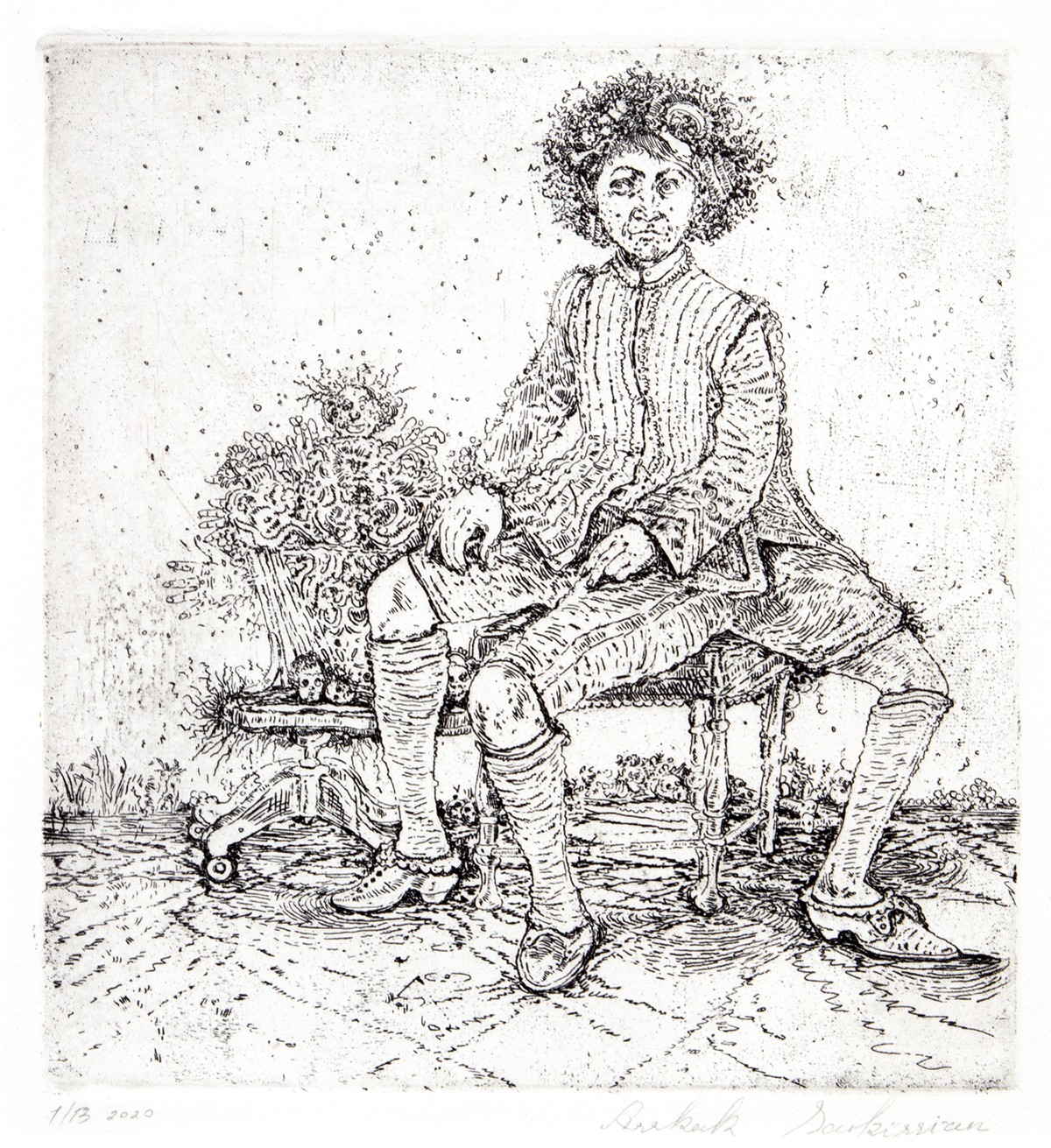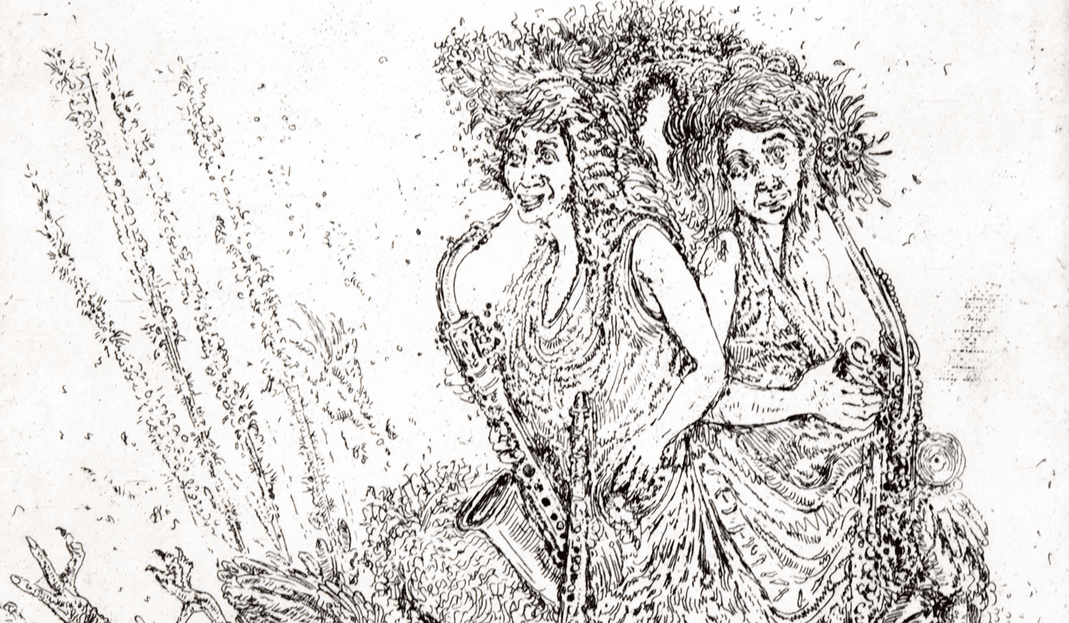

Arshak Sarkissian’s project Freak Show presents eight etchings dedicated to the phenomenon of the freak show. Both the subject and the manner of execution evoke Francisco Goya’s Los Caprichos, and Sarkissian’s allusion to Goya is clear.
Writing about Los Caprichos, Goya described how painting, like poetry, selects from reality the features and circumstances most appropriate to its purpose, combining elements found in many different individuals into an imaginary figure. Through this process, the artist becomes an inventor rather than a mere copyist. This idea offers a particularly precise way of approaching Arshak Sarkissian’s poetic visual language.
In Freak Show, Sarkissian turns to visual archives. The works are based on archival photographs of freak show performers. Visual culture changes together with technology, and etching itself can be understood as a medium closely connected to the visual archive. The freak show also belongs to such an archive: a nineteenth-century phenomenon preserved largely through the black-and-white photography of its time.
These archival layers give Sarkissian’s works their intensity and serve two interconnected purposes: to explore the origins of modern representations of the body and the archive through which bodies have been classified and represented, and to recall ways of depicting the human body that have now almost disappeared.
Today, the freak show no longer exists in the form in which it developed during the nineteenth and early twentieth centuries. Following the devastation of the First and Second World Wars, and particularly the suffering experienced by millions of people with disabilities, public attitudes changed. Audiences either lost interest in such spectacles or they became socially and legally unacceptable.
Another important factor was the increasing medical supervision and classification of bodies according to ideas of normality and abnormality. One of the most famous historical freak show figures, Joseph Merrick, known as the Elephant Man, became the subject of medical observation and research and spent the final years of his life at the London Hospital.
In the nineteenth century, however, attitudes toward freak show performers were very different. They were not necessarily understood as disabled in the modern sense, particularly because many of them worked professionally and could earn significant amounts of money. Ella Harper, known as the Camel Girl, for example, reportedly earned $200 per week while performing with W. H. Harris’s Nickel Plate Circus at the height of her career in 1885–1886.
The phenomenon of the freak show returned strongly to cultural memory through David Lynch’s 1980 film The Elephant Man. The film was widely recognized for its humanistic approach to Joseph Merrick. Lynch described the story as being about a person who appeared monstrous from the outside while being beautiful and entirely human within. For Lynch, distorted human conditions could reveal what remained undistorted beneath them.
In the film, Merrick is presented neither simply as a Stranger nor as the Other, but as someone Different — a person with whom communication, empathy and emotional connection are possible.
Arshak Sarkissian’s approach is both close to and distinct from Lynch’s. Speaking about his artistic practice, Sarkissian explains that he studies human behavior in search of a particular expressiveness that he calls personality. He is drawn to people whose personalities have been shaped through their biographies and experiences, to people who experiment with themselves and undergo transformations. Such experiments may turn the personality into something monstrous or hybrid, incorporating animal or plant-like elements.
Within Freak Show, Sarkissian similarly emphasizes that the performers he depicts are neither the Stranger nor the Other. They are the Different, and the act of making art becomes a way of communicating with them.
This is one of the most radical aspects of Sarkissian’s approach: he does not attempt to discover conventional normality beneath the image of the monster. Instead, through the artistic image itself, he makes these figures intimate, sympathetic and worthy of affection.
The monstrous is traditionally understood as a deviation from the norm. It can therefore also function as an allegory of transformation and change. Philosopher Slavoj Žižek has discussed the monster as a figure that can embody different forms of disruption: social revolution, rebellion against established authority, industrial transformation, unconventional reproduction and scientific knowledge. In this sense, monstrosity becomes connected not only with physical difference but also with the possibility of breaking established boundaries.
Joseph Merrick, the Elephant Man, was historically associated with severe bodily deformity. His condition was later widely discussed in relation to Proteus syndrome, a rare disorder named after Proteus, the ancient Greek god capable of changing his bodily form.
Within Sarkissian’s project, the transformed or “abnormal” body acquires another symbolic meaning. It can be read as an image of human life resisting political, medical or other systems of supervision that attempt to define what a body should be.
Freak Show ultimately confirms Arshak Sarkissian’s enduring sympathy toward different manifestations of human life. Rather than treating bodily difference as spectacle or anomaly, the project transforms historical images of difference into a reflection on individuality, transformation, freedom and human dignity.
Text by Vardan Jaloyan
Art Critic and Cultural Theorist
Member of AICA
Vardan Jaloyan is an Armenian art critic, cultural theorist and essayist whose writing focuses on contemporary art, visual culture and cultural theory
The etches were shown at:
Angels and Demons, Palazzo Chigi in Ariccia and Centro Saint-Benin Museum, ( Traveling Exhibition) curated by Dominque Lora, Rome, Italy (2022)
https://www.arshaksarkissian.com