
Taguhi Torosyan:
It began with dislocation, both geographical and perceptual.
Moving across different countries and regions in Europe, I found myself not just encountering new art scenes, but relearning how scenes exist at all. How they become visible, how they sustain themselves, how solidarity is practiced or fails. At the same time, something else was happening more quietly. I was unlearning what I thought I knew about the scene back home.
Years passed. In Yerevan, spaces closed, others emerged, and people moved in and out. The scene kept shifting, but from a distance it became harder to grasp. The sense of its present, its rhythm, its internal logic, its Zeitgeist, began to dissolve.
During that period, across different projects, I co-founded femaleartistindex.org in Vienna, a directory of female* artists, and became closely involved with the Independent Space Index and its annual festivals. That experience stayed with me. The Index was not just a database. It was a living infrastructure, community-run and collectively maintained, activated through simultaneous events across the city. It offered a way of seeing a scene not as a fixed map, but as something relational, distributed, and alive.
When I eventually returned to Yerevan, reconnecting was not immediate. It took time to understand what had changed, and even more time to find my way back into it. Small things did not help, such as deleting my old Facebook profile, which had years' worth of connections to artists and venues. Suddenly, the informal infrastructure I relied on was gone. Most of the time, I did not know where to go, what to see, or who was doing what.
Instagram helped, partially. It gave access to newer, often Gen Z-led initiatives. But much of the established scene was still operating through Facebook, which meant rebuilding that network from scratch. The fragmentation was real. The information was there, but it was not accessible unless you already knew where to look.
When I founded Ars Techne in 2022, a platform operating at the intersection of art, science, and technology, I understood that building visibility would take time. But a more fundamental question kept returning.
Where is the map?
Because in practice, there was none. If you were not on the right platforms, you simply did not see the scene. Visibility was conditional, uneven, and often accidental, something Ars Technica itself is committed to addressing through open knowledge and accessible infrastructure.
This question became even more concrete as we launched the Mattering Worlds: Media Art in More-than-Human Ethics and Ecology residency program at Ars Techne. One of the most frequent questions we received from our residents was disarmingly simple. Where should we go? What should we see? It revealed a structural gap that affected not only local audiences but also international visitors.
Two years later, while studying UI and UX, I chose to focus directly on this problem. For my capstone, I began developing an art events application. I started with user research, talking to friends, colleagues, and people in wider networks on Facebook and Instagram. At the same time, I was doing something parallel. I was reconstructing the scene itself.
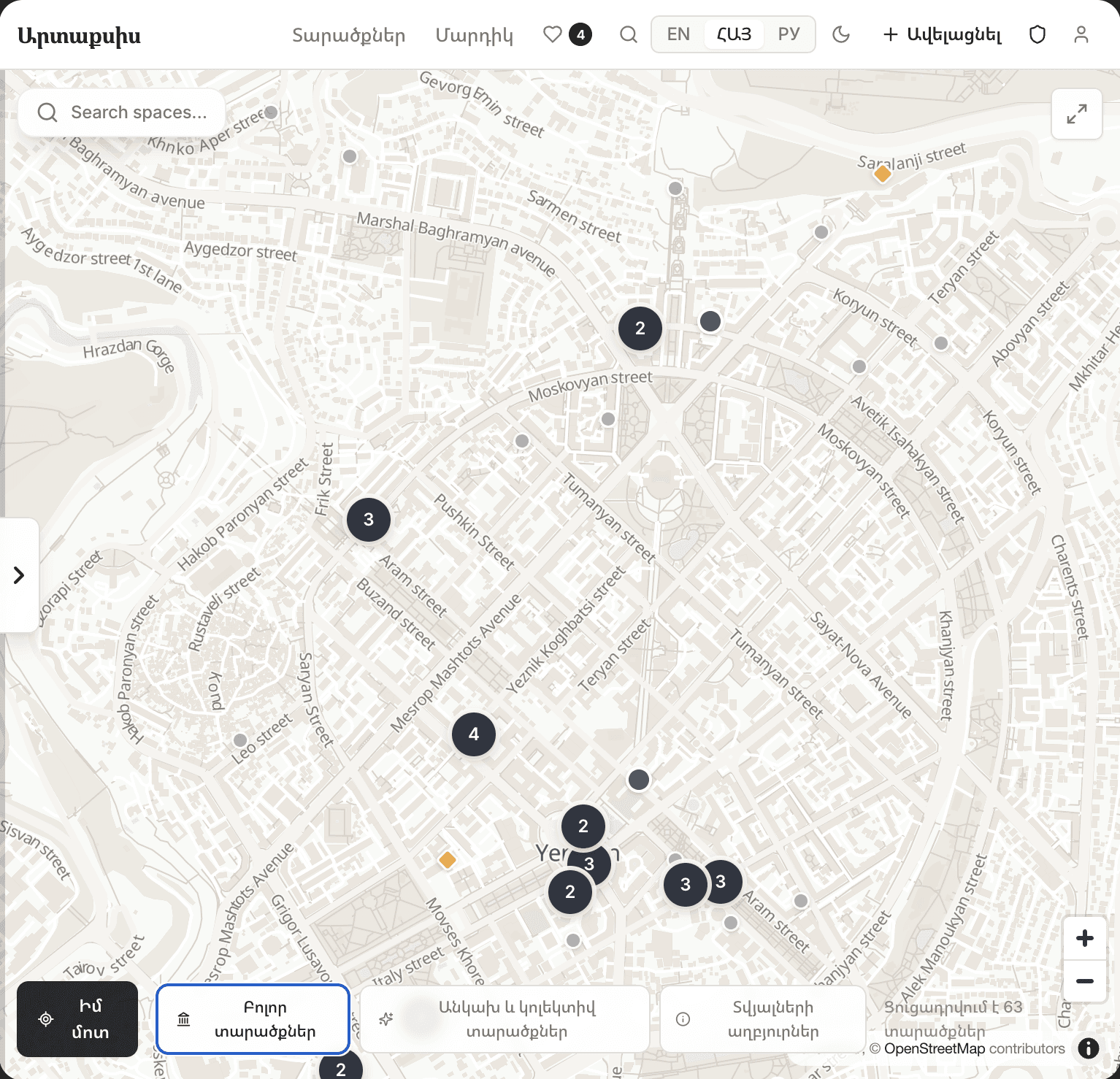
Drawing from personal memory, collective recollection, and scattered online traces, I began mapping both active and inactive independent art spaces in Yerevan. This process resulted in the Independent Spaces Index Yerevan, along with its open database and a monthly publication.
The more I worked on it, the clearer it became. The issue was not a lack of activity. It was a lack of structure, continuity, and shared access.
Artaxis emerged from that realization.
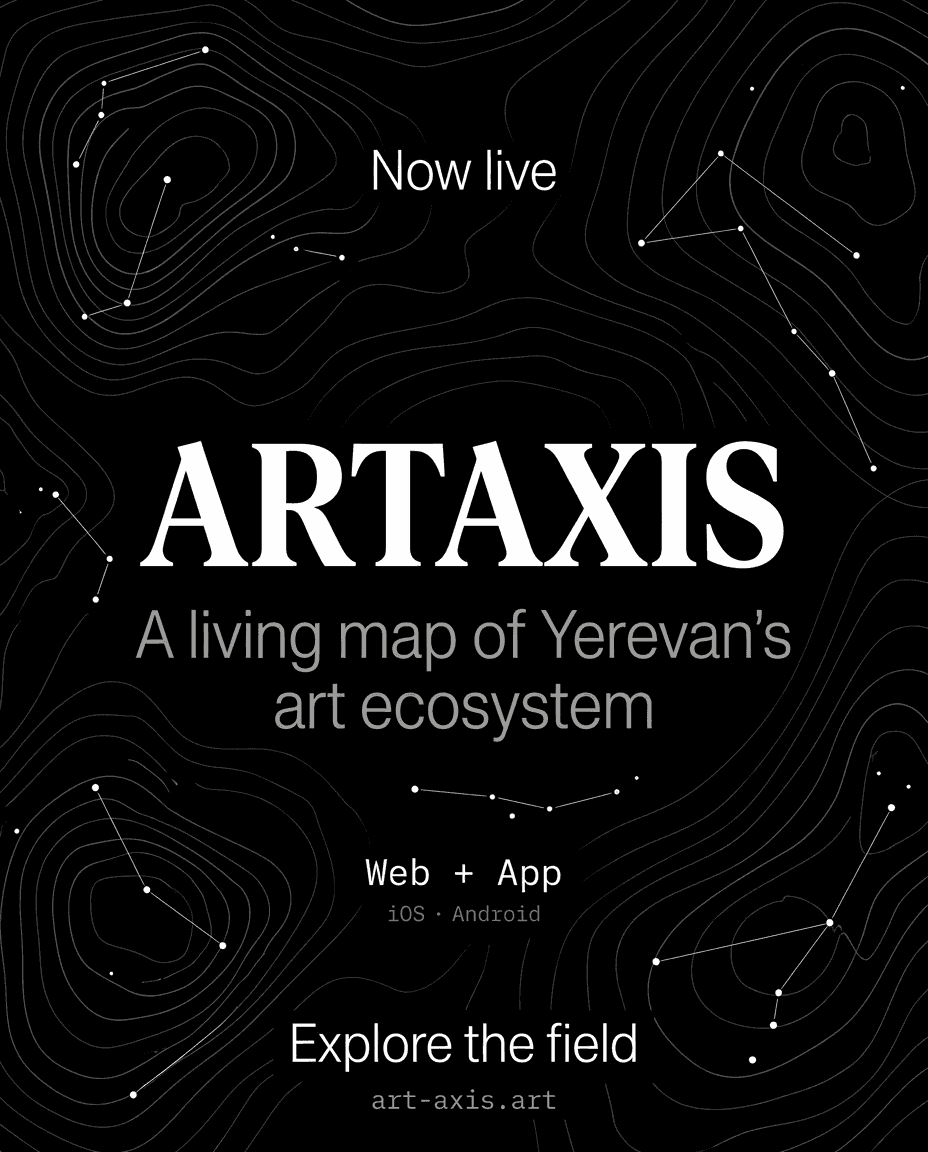
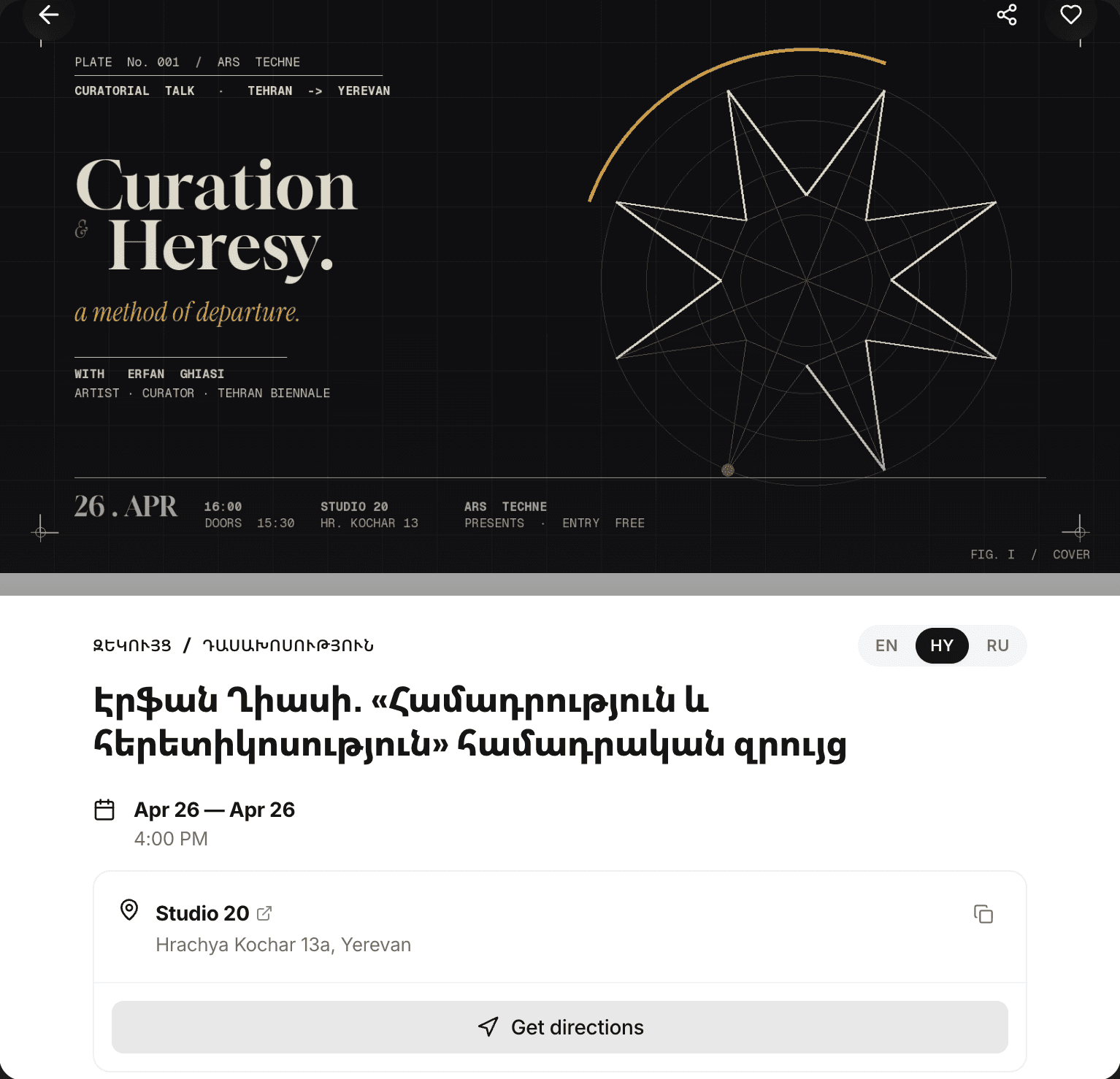
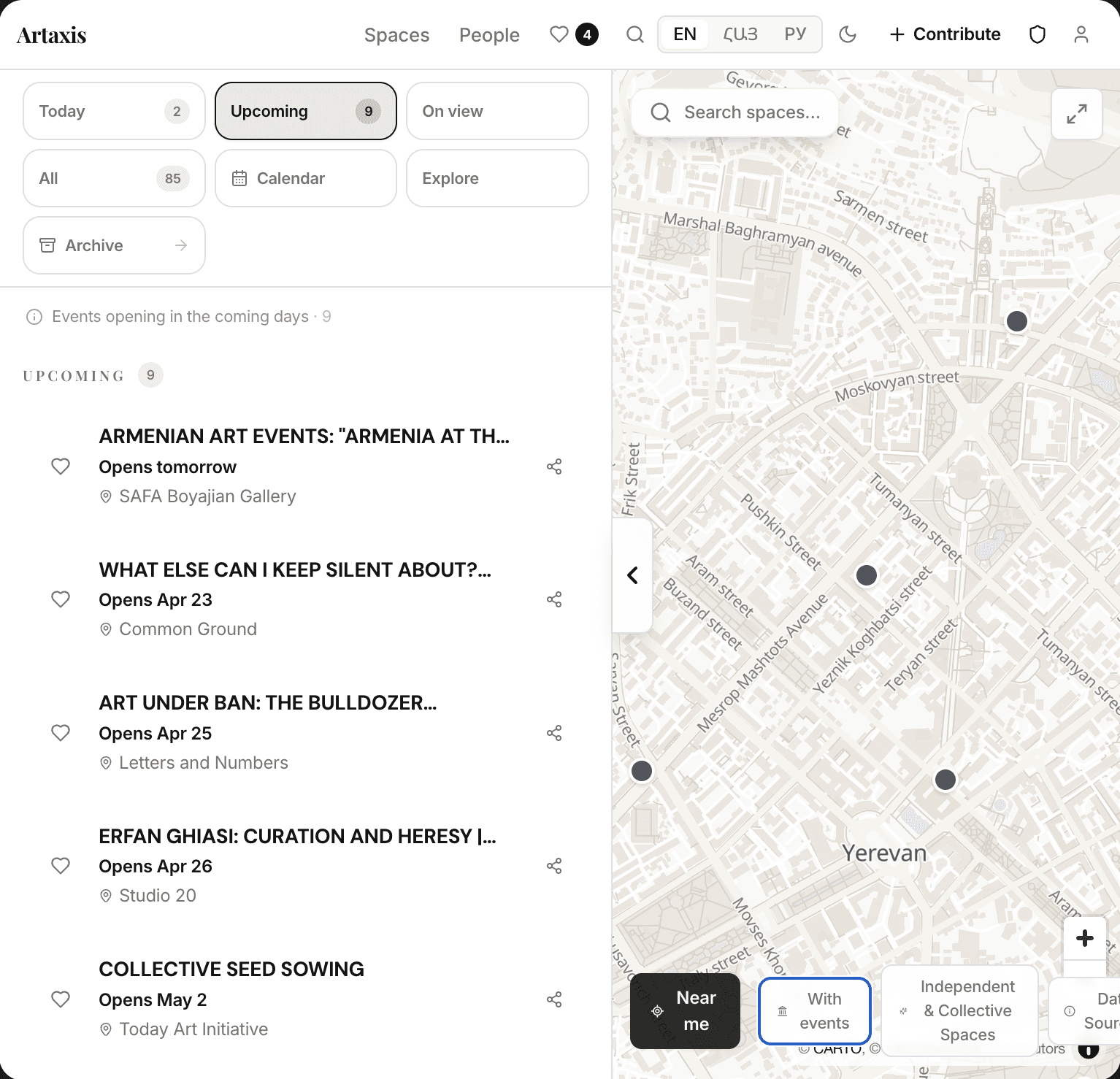
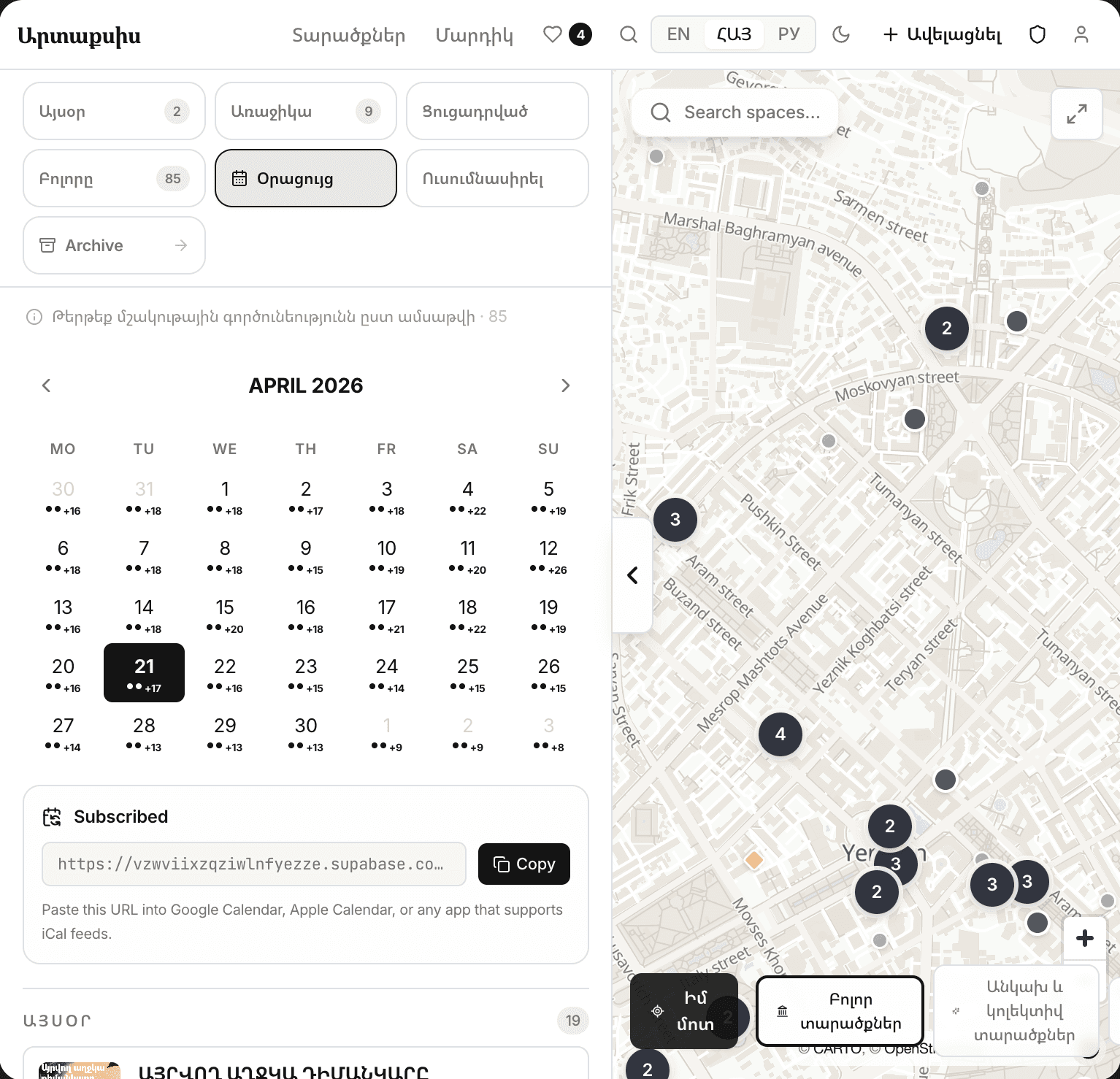
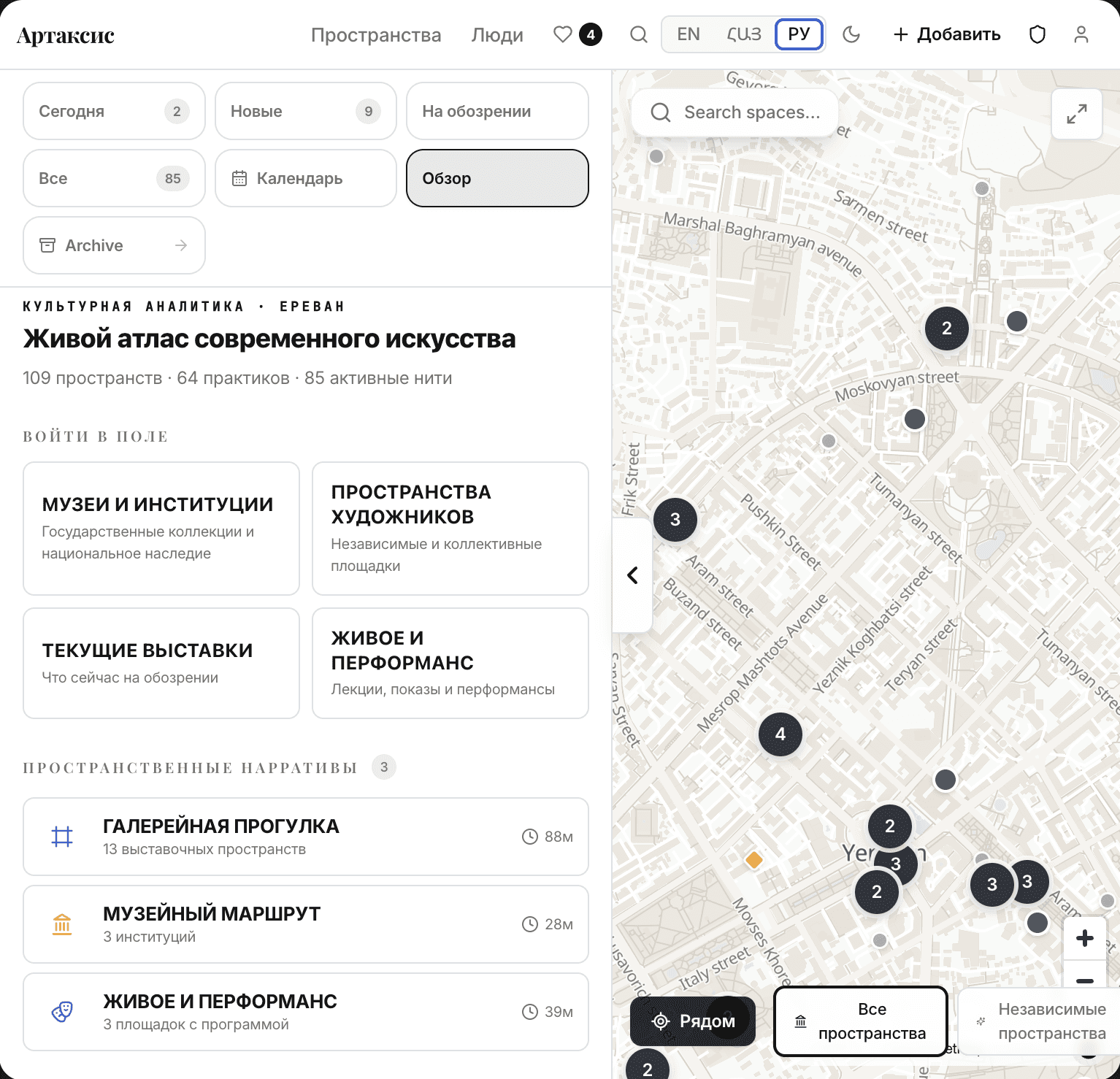
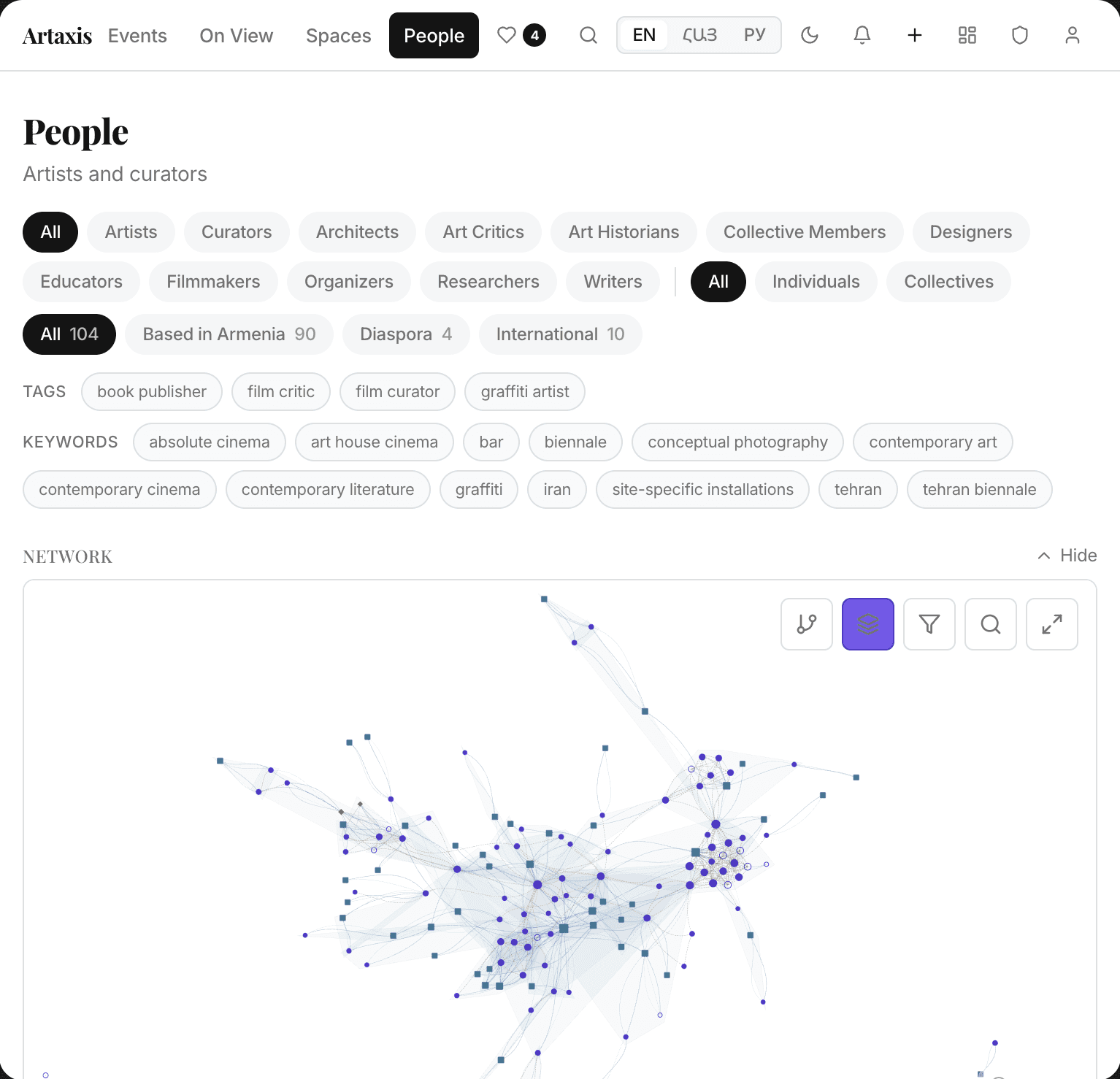
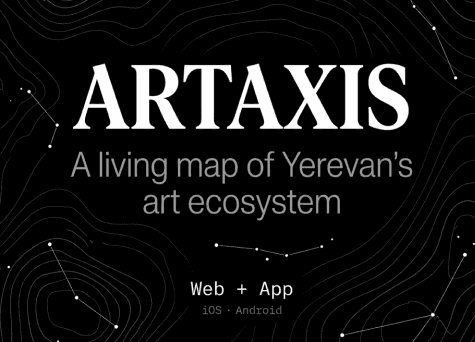
Artaxis is a Progressive Web Application, a PWA, designed as a living interface for navigating contemporary art scenes. It brings together event discovery and browsing, saving and personal calendars, subscriptions to venues and initiatives, and a continuously updated map of spaces across the city. At its core is a relational, rhizomatic network that connects artists, curators, collectives, and venues, allowing users to move through the scene through associations rather than fixed paths.
The platform is community-driven. Users can contribute events, expand profiles, and actively shape the ecosystem itself by adding people, collectives, and spaces that may otherwise remain invisible. There is also a review layer that allows visitors to leave feedback and share experiences, adding a qualitative dimension to the archive as it grows. In this way, Artaxis not only aggregates information, it also accumulates perspectives. It also builds on ongoing research initiatives such as the Independent Art Spaces Index Yerevan, making visible both active and dormant infrastructures of the scene. Designed for accessibility and immediacy, Artaxis can be installed directly from the browser to a mobile home screen, offering an app-like experience without requiring download from the App Store or Google Play, where it is not yet available.
Early analytics reflect both the density of the scene and the conditions under which it becomes visible. In a short period, more than 130 events have been indexed, along with over 120 venues and close to 100 artists and curators. The distribution of events spans exhibitions, screenings, talks, workshops, and performances, with a noticeable concentration in central districts such as Kentron and Cascade. At the same time, most of this information has been gathered from dispersed sources, including websites, Telegram channels, and manual submissions, pointing to a landscape that exists but remains structurally fragmented.
What emerges is not a lack of activity, but a lack of shared infrastructure. While the informational layer is rapidly forming, participatory features such as saving, following, and installation are still in their early stages, suggesting that the platform is only beginning to be inhabited. Artaxis, in this sense, is not simply an app. It is an attempt to assemble a field of relations. A way to make a scene legible, navigable, and collectively maintained as it continues to unfold.
Taguhi Torosyan is a curator, artist, and researcher based in Yerevan. She is the founder and artistic director of Ars Techne, a platform exploring the intersections of art, science, and technology with a focus on ecology, open knowledge, and more-than-human perspectives. Her practice spans installation, photography, and research-based work, engaging with infrastructures, memory, exhaustion, and collective care.
Taguhi has exhibited and presented internationally, including at apexart (New York), Cyland Media Art Festival (Yerevan), EVA Copenhagen, and Art Factory Łódź. She is a co-founder of the Female* Artist Index and has contributed to research and curatorial projects in Vienna, including the Transfeminist Hacking initiative at the Academy of Fine Arts. Her writing has been published in Springerin, EVN Report, and Politics of the Machines: Rogue Research, among others.
She holds an Erasmus Mundus MA in Media Arts Cultures and works across curatorial practice, artistic research, and cultural infrastructure building, with a particular interest in mapping, interspecies communication, and post-media conditions.
Namor Votilav
In my previous life, I ran an art space in an industrial city that was disenchanted with itself, where the community had fallen apart a dozen times over, where people constantly drained to capitals and abroad. My function, as I believed, was to build space for connection, to create opportunities for crossover, for meetings beyond exhibitions. I didn’t fully get it at that time, but it came so easily to me that it never felt like work. In our 3 active years, we grew the artist-visitor community to 5000 people, hosted 12 big exhibitions, a city festival, and countless events, spawned several new spaces, and we had so much fun.
When I first arrived in Yerevan, the art scene seemed unreachable — you had to know somebody. Also, unlike today, few people posted on Instagram, and even to know where to go, you needed to do some research. Half a year into my move, I stumbled into :DDD Kunst House, met the people there, then their friends and colleagues and teachers, and eventually I was in the know. New friendships came easily, but still, starting over was stressful. My place in the art system was not yet defined.
Later, I got to meet more and more cultural workers, work with them (culturally), learn how their institutions operate, how they make creative and organizational decisions, and how hard support comes to be, and it wasn’t difficult to understand why connection is far from the first priority at the moment. There is no criticism in my words — it is genuinely hard to run a creative space, manage your own program, and then also to make time to visit somebody else’s project, listen in on a lecture, and more so to build up mutual context.
My first attempt at organizing the connective space was a telegram announcements channel. I thought it would be a great thing for newcomers to the scene and the city, a useful planning tool for organizers, and also an archive. While it is all of those things, it’s quite hard to manage — I still have to keep tabs on 25+ social media pages. The complexity has just shifted from all the people doing the discovery work to me, and I get too lazy with it from time to time. I’m also not alone — Sona Arsenyan and Catherine Chernova have similar channels, Vigen Galstyan has a column, and I’m sure there are many more I don’t know about. The next attempt was a shared Google Calendar, where the organizers would post events for visitors to receive via notifications. It also kinda works, but few organizers have joined the initiative consistently, and it’s impossible to gather any data if it’s even doing a good job.
Joining forces with Taguhi, we are now taking a more structured approach. It was obvious from the start that the way to keep up with the community is to let the community tell its own news — announce events, document exhibitions, and self-archive. Art-axis is a community hub that hosts events, maps the organizations, and archives people’s efforts. I really want it to be a go-to for all things in Armenia's creative community. Now it’s still a long way to go; we have to figure out the basics and the infrastructure to make it convenient and resilient. But the initial response we are getting for the art-axis is giving us hope.
Namor Votilav is a curator and artist based in Yerevan. His works explore the interfaces between people, means, and problems of clear communication. His main focus is on community building. He is a co-founder of a self-proclaimed contemporary art center, ‘Klopovnik’ in Chelyabinsk, Russia.
References
Female* Artist Index. femaleartistindex.org.
Available at: https://femaleartistindex.org
Independent Space Index. independentspaceindex.at.
Available at: https://www.independentspaceindex.at/
Ars Techne. arstechne.net.
Available at: https://arstechne.net/
Ars Techne. Mattering Worlds: Media Art in More-than-Human Ethics and Ecology (Residency
Program).
Available at: https://arstechne.net/programs/residency-mattering-worlds
Ars Techne. Independent Art Spaces Index – Yerevan.
Available at: https://arstechne.net/independent-spaces-yerevan
Ars Techne. Open Data.
Available at: https://arstechne.net/open-data
Ars Techne. Independent Art Spaces Index – Yerevan (Publication).
Available at: https://arstechne.net/independent-spaces-yerevan#publication
Artaxis. art-axis.art.
Available at: https://art-axis.art/en
Taguhi Torosyan, taguhitorosyan.com.
Available at: https://taguhitorosyan.com/